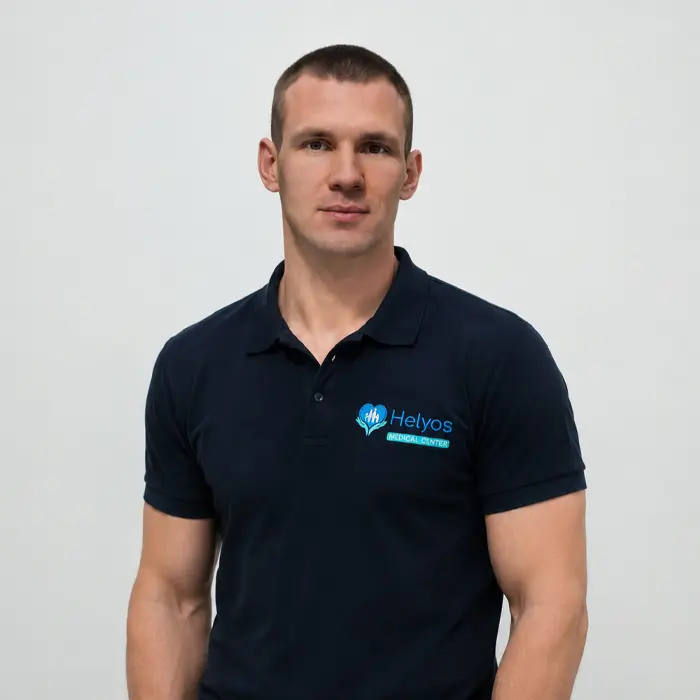
Kirill Aleksandrovich Seleznev

Kirill Aleksandrovich Seleznev

Doctor
Work Experience: 26 years
Specialty:Orthopedist - Traumatologist
Specialization: Orthopedic traumatologist
Work expirience:26 years
Education:

Higher Medical Education

PhD (Medical Sciences)

Responsibilities:

- Initial and follow-up consultations with an orthopedic traumatologist

- Evaluation of X-ray, CT, and MRI results

- Intra-articular and para-articular injections

- Therapeutic blockades

- Joint punctures

- Application and removal of plaster and polymer casts

- Postoperative wound dressings

- Suture removal

- Medical documentation


Treats:

- Bone fractures and their consequences

- Dislocations, subluxations, sprains, and ligament ruptures

- Contusions, hematomas, and other musculoskeletal injuries

- Arthrosis (gonarthrosis, coxarthrosis, omarthrosis, ankle arthrosis, etc.)

- Arthritis of various types origin

- bursitis, tendinitis, tendovaginitis, ligamentitis;

- Epicondylitis (tennis elbow, golfer's elbow)

- Heel spurs (plantar fasciitis)

- Carpal tunnel syndrome and other tunnel syndromes

- Foot deformities (flat feet, hallux valgus, hallux valgus)

- Joint contractures

- Postural disorders

- Degenerative-dystrophic diseases of the spine

- Consequences of trauma and surgery

- Pseudarthrosis and malunion fractures

- Aseptic necrosis of the femoral head

- Meniscus and ligament damage of the knee joint

- Shoulder disease (adhesive capsulitis, impingement syndrome, etc.)

- Musculoskeletal pain syndromes

- Osteoporosis and its complications

- Consultation on conservative and surgical treatment of orthopedic and trauma pathology

- Postoperative monitoring and rehabilitation of patients

Directions of Treatment:
Orthopedic traumatologist in Dnipro
Make an appointment
Enter your full name
Enter your phone number
Choose a specialist
Choose a specialist
Choose a branch
Choose a branch
Kirill Aleksandrovich Seleznev
News
All news
Sign the declaration in 5 minutes

Sign the declaration with a family doctor at Helios Family Health and Rehabilitation Medical Center

Sign a declaration with a family doctor (you can do it in any center of Helios medical center or you can call +38 067 000 01 50 and our staff will help you to sign a declaration with a family doctor).

Declaration with a family doctor in Helios is:

- The possibility of a free consultation in 7 branches of the Helios medical center

- Family doctor consultation in the clinic and at home

- Blood pressure measurement

- Electrocardiogram

- Sick leaves and certificates for kindergarten, school

- Basic tests: general blood and urine tests, blood glucose, total cholesterol, rapid tests (HIV, viral hepatitis, troponin, pregnancy).

- Access to the state vaccination program to prevent infectious diseases

- Prescriptions for medications, particularly through the Affordable Drug Program with an electronic prescription from your physician

- Our family physicians diagnose and treat all family members regardless of gender or age.

-10% deposit to your own account from each consultation

The number of visits to the family doctor is NOT LIMITED!

You can also sign the declaration on behalf of other family members - a child or an elderly relative who does not use a cell phone. Parents or guardians only need to come with their documents, bringing the child's birth certificate or the passport and code of the elderly person.

*Documents required to sign a declaration with a doctor: Passport + TIN.

MYOSITIS: WHAT PATIENTS NEED TO KNOW

Muscle pain and weakness are symptoms that many people attribute to fatigue or a cold. However, they can sometimes be signs of a serious condition—myositis. Understanding this condition will help you see a doctor in time and start the right treatment.

What is myositis?

Myositis is an inflammation of muscle tissue. The term “myositis” encompasses both common inflammation following overexertion or exposure to cold, as well as serious autoimmune diseases: polymyositis, dermatomyositis, and necrotizing autoimmune myopathy.

In autoimmune forms, the immune system mistakenly attacks the body’s own muscles, causing chronic inflammation. Without treatment, this can lead to persistent weakness, muscle atrophy, and serious complications.

How to recognize myositis: main symptoms

Look for the following signs:

•       Muscle weakness—especially in the shoulders, hips, and neck; difficulty getting up from a chair or raising your arms.

•       Muscle pain—may be constant or worsen with movement and palpation.

•       Increased fatigue—even after minimal physical exertion.

•       Muscle atrophy — with a prolonged course of the disease, muscle mass may decrease, and strength and endurance may decline.

•       In dermatomyositis, characteristic skin rashes may appear: redness around the eyes (the “goggle” sign), and rashes on the finger joints.

•       Possible difficulty swallowing or shortness of breath — if the throat muscles and respiratory muscles are affected (this requires immediate medical attention!).

⚠ Important: If you experience severe shortness of breath, difficulty swallowing, or a sudden worsening of your condition, contact a doctor immediately or call an ambulance.

Why does myositis occur?

The causes can vary:

•       Autoimmune processes—the most common cause of chronic myositis.

•       Viral and infectious diseases—the flu, strep throat, and other infections can trigger muscle inflammation.

•       Injuries and excessive physical exertion.

•       Exposure to cold and prolonged exposure to drafts.

•       Taking certain medications (for example, statins—drugs used to lower cholesterol).

•       Concomitant connective tissue diseases (lupus, scleroderma).

•       Cancer — in some cases, myositis may be the first sign of a tumor.

Treatment and rehabilitation

According to the clinical guidelines of the Ministry of Health of Ukraine, treatment is selected based on the form and cause of myositis. Properly prescribed therapy significantly influences the course of the disease and the prognosis.

Drug treatment

•       Corticosteroids (e.g., prednisolone)—the main treatment for autoimmune myositis, reduce inflammation.

•       Immunosuppressants (methotrexate, azathioprine) — prescribed when corticosteroids are not effective enough.

•       Anti-inflammatory drugs — to relieve pain and swelling.

•       Antibiotics — if myositis is caused by a bacterial infection.

Rehabilitation

Rehabilitation is an integral part of treatment and includes:

•       Physical therapy — a personalized exercise program to restore muscle strength.

•       Physical therapy procedures — to improve blood flow and reduce inflammation.

•       Massage — as a supplement to the main treatment.

Important to remember

•       Do not self-medicate—myositis requires an accurate diagnosis and a doctor’s prescription.

•       Seeking timely medical attention and receiving proper treatment significantly improve the prognosis.

•       Follow rehabilitation recommendations—this will speed up recovery.

•       Avoid triggering factors: hypothermia, excessive physical exertion, and stopping medication on your own.

•       Visit your doctor regularly to monitor your condition and adjust your treatment.

Diagnosis and Rehabilitation at Helios

At the Helios Medical Center, we conduct comprehensive diagnostics, monitor the course of the disease, and develop a personalized treatment and rehabilitation program.

An important part of recovery is properly selected physical rehabilitation and therapeutic exercises, which help maintain muscle strength, reduce the risk of atrophy, and improve the patient’s quality of life.

If you experience muscle weakness, pain, or rapid fatigue, it is important to consult a specialist promptly.


V.L. Kovalenko — Physician of Physical and Rehabilitation Medicine (PRM)